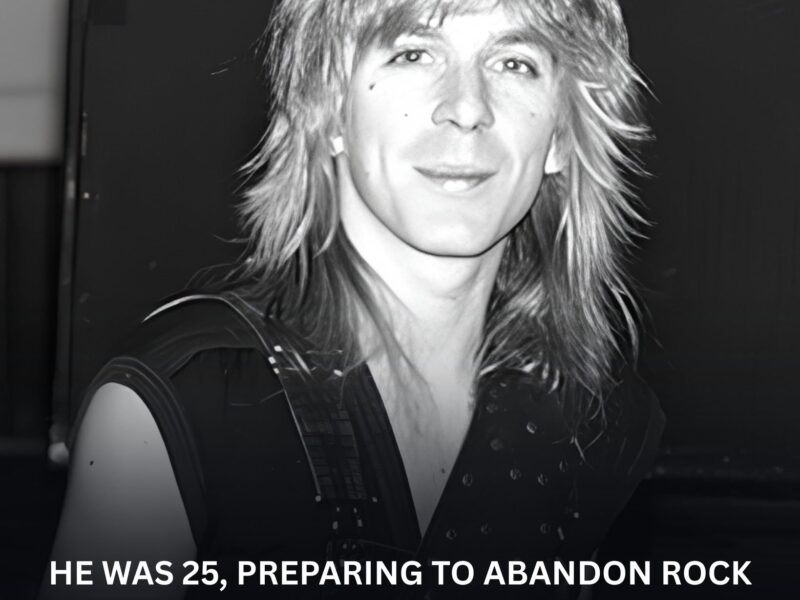
The last thing Randy Rhoads said to Ozzy Osbourne was a warning.
The last thing Randy Rhoads said to Ozzy Osbourne was a warning.
They had argued that night on the tour bus, the way people who genuinely care about each other argue, bluntly and without ceremony, about Ozzy’s drinking. Randy was quiet by nature, soft-spoken in a world that rewarded volume. But that night, on a bus rolling through Florida in the dark, he looked at Ozzy and said what he had been thinking for a while.
“”You’ll kill yourself, you know? One of these days.””
Then he went to sleep. He was twenty-five years old.
Randall William Rhoads was born on December 6, 1956, in Santa Monica, California, the youngest of three children in a family built entirely around music. Both parents were music teachers. His mother Delores had a degree from UCLA and played piano professionally. His father left when Randy was barely eighteen months old, leaving Delores to raise three children alone. She opened a music school in North Hollywood called Musonia. Randy started taking guitar lessons there at age seven.
By fourteen, his guitar teacher went to Delores and told her he could no longer teach her son, not because Randy had failed, but because Randy had surpassed him. He had exceeded what his instructor knew how to give him.
Randy went further on his own. He studied classical guitar formally, absorbing Bach and Beethoven with the same seriousness he brought to heavy metal.

He took piano lessons from his mother to understand theory from the inside out. By sixteen he was teaching guitar at Musonia himself, giving lessons during the day and playing gigs at night. He graduated from Burbank High School early to have more time for music.
In 1979, a friend named Dana Strum kept calling him about an audition for a fired Black Sabbath singer trying to put together a solo band. Randy agreed mostly to make Strum stop calling. He arrived with a Gibson Les Paul and a small amp. Ozzy Osbourne, by his own cheerful admission not entirely sober, was completely electrified within thirty seconds. He hired Randy on the spot.
What followed was two years of work that reshaped the sound of heavy metal. Blizzard of Ozz in 1980. Diary of a Madman in 1981. The opening riff of “”Crazy Train.”” The architecture of “”Mr. Crowley.”” Randy took the harmonic logic of classical music and fused it with the raw voltage of metal to create something that had a name nobody had used yet: neoclassical metal.
On tour, he would find local music teachers in whatever city they happened to be in and pay for lessons. His bandmates found this baffling. He told them he still had things to learn.
By 1981, he had started telling people he was thinking about leaving. Not leaving music. Leaving rock. He wanted to go to UCLA and study classical guitar full-time. Friends say it wasn’t a vague idea. It was a plan.
He never got to go.
On the night of March 18, 1982, after their last show of the tour at the Knoxville Civic Coliseum, the band boarded a bus headed for Orlando. They stopped at Flying Baron Estates in Leesburg, Florida to fix a broken air conditioning unit. Most of the band went back to sleep.
The tour bus driver, Andrew Aycock, was a licensed pilot whose license had expired. He found a Beechcraft Bonanza on the property, took the keys without permission, and began flying low passes over the bus. Randy, half-asleep and reportedly talked into it, climbed aboard for the second flight along with the band’s 58-year-old seamstress Rachel Youngblood.
The plane clipped the tour bus on a third low pass, lost control, and crashed into a nearby house. All three were killed instantly.
Ozzy has said in the years since that he never fully got over it. That Randy gave him purpose when he had none. That Randy was the best guitarist he ever heard. That if Randy had lived, he would have ended up somewhere beyond what any of them could have predicted.
Randy Rhoads was inducted into the Rock and Roll Hall of Fame in 2021.
He was twenty-five years old when he died.
He had already changed music.
He was just getting started.