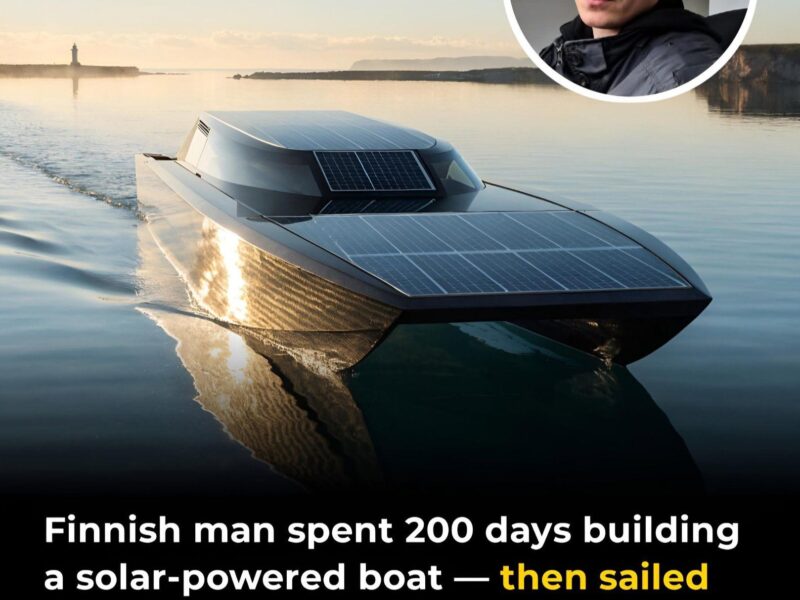
A Finnish builder turned plywood and solar panels into an 11-meter yacht that runs on sunlight alone. He built the whole thing solo in a shed for less than the price of a new car
Owning a boat usually means signing up for a lifetime of fuel bills, marina fees, and an engine that wants attention every few months. That is the deal almost everyone accepts before they ever cast off. A Finnish builder named Lukas Sjoman wanted none of it, so he spent roughly 200 days in a shed turning plywood, glass fibre and off-the-shelf solar panels into an 11-meter explorer yacht that runs on sunlight alone. His pitch is simple: a boat designed to, in theory, run forever.
And this spring he spent about $1,900 on a battery upgrade to push it even farther without burning a single drop of fuel.
The boat is called Helios 11, and if you have watched any of it come together on his True North Yachts channel. Blacked-out, narrow, stripped of anything that is not holding the thing together. That austerity is the entire point. Every kilogram Sjoman did not add is a kilogram the sun does not have to move, and that math is what separates a slogan about running forever from a boat that actually crosses water. It is also one of the more extreme attempts yet to put electric propulsion on the water, except this one was built by one person for less than the price of a mid-size sedan.
The $1,900 upgrade is two batteries and a lot of restraint
The upgrade itself is almost boring, which is sort of the flex. Sjoman added two more 48V 100-amp battery packs, bringing roughly 22 kilowatt-hours of usable storage to the solar propulsion system, according to the build he has documented publicly. Combined with what the roof array feeds in, the whole setup tops out near 37 kilowatt-hours of energy on a good day. The roof itself generates somewhere around 15 kilowatt-hours in typical conditions, which is what keeps the batteries topped up while the boat is moving, instead of needing a plug once the sun goes down.
He bolted the new packs low, beneath the waterline, and that placement does double duty. It adds capacity, and it drops the center of gravity to counter the weight of all those panels sitting up on the roof. He could have chased a better power-to-weight ratio with flexible CIGS panels, but those yield less per square meter and cost more, so he stuck with cheaper rigid panels and kept the whole battery job inside that $1,900 budget. The hull is also built to self-right, which matters a lot more on a light boat than on a heavy one.
The amenities are the part that turns a science project into a home. There is an electric stove, a lightweight fridge, and a flushable toilet on board, and Sjoman has talked about adding rainwater harvesting, water filtration, and Starlink so the boat can stay away from a marina for weeks at a time. It is a 1.5-ton apartment that happens to float and never visits a gas dock.
Range on a solar boat is a moving target
This is where the phrase “runs forever” needs an asterisk, because the number moves depending on the sky. On a standard 24-hour run, Sjoman says the upgraded Helios 11 covers about 100 nautical miles without touching fuel. On a bright summer day with the auxiliary sail up, that can stretch toward 150. Push it into rougher water with the sun behind clouds and the daily figure drops closer to 40. None of that is a knock on the boat. It is just what solar range looks like when your fuel tank is the weather.
The cruising speed sits in a useful band too, roughly 5 to 5.5 knots, which is where the electric motor runs most efficiently. Go faster and you drain the batteries; go slower and you are barely moving. Sjoman has settled into that efficient cruise the way a hypermiler settles into 55 on the highway, except his reward is a boat that quietly refills itself once the sun comes back up.