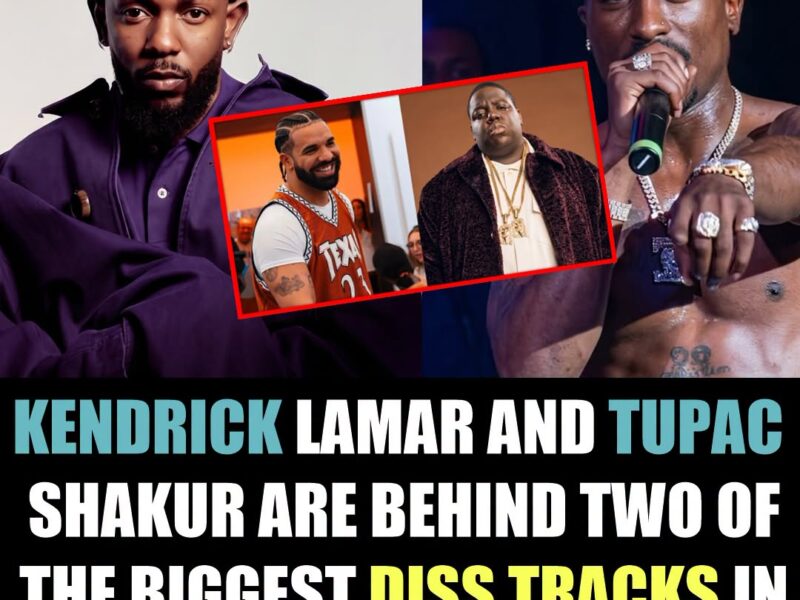
TUPAC VS. KENDRICK LAMAR: “HIT ’EM UP” OR “NOT LIKE US” — WHICH DISS TRACK HAD THE BIGGER IMPACT?
Hip-hop has always had battles.
Rappers have challenged each other through lyrics, interviews, songs and performances for decades. But every once in a while, a diss track escapes the boundaries of a rap feud and becomes something much bigger.
That is exactly what happened with Tupac Shakur’s “Hit ’Em Up” in the 1990s.
And almost three decades later, it happened again with Kendrick Lamar’s “Not Like Us.”
Two artists.
Two generations.
Two completely different eras.
But one fascinating question:
Which diss track had the greater cultural impact?
TUPAC HAD “HIT ’EM UP”
Released in 1996, “Hit ’Em Up” became one of the most infamous diss tracks in hip-hop history.
Tupac didn’t approach the song cautiously.
He went directly at his enemies.
The track was part of the intense East Coast–West Coast conflict surrounding Tupac, Death Row Records and Bad Boy Records.
Its aggression was immediate.
Its lyrics were confrontational.
Its energy was explosive.
And most importantly, people couldn’t stop talking about it.
The song wasn’t simply another record.
It became a defining document of one of the most turbulent periods in hip-hop.
WHY “HIT ’EM UP” FELT SO DIFFERENT
Part of the song’s impact came from Tupac’s delivery.
He sounded furious.
There was no attempt to disguise the emotion.
No subtle messaging.
No complicated interpretation required.
The listener immediately understood that Tupac was attacking his rivals.
That directness made the record unforgettable.
But there was another reason it became so significant.
The conflict surrounding the song was already receiving enormous attention from the media.
Hip-hop was becoming increasingly mainstream, and the rivalry between the East Coast and West Coast scenes had become a national conversation.
“Hit ’Em Up” poured gasoline onto an already burning fire.
THEN CAME KENDRICK
Fast-forward almost 30 years.
Hip-hop had changed completely.
Streaming had transformed the music industry.
Social media could turn a lyric into a viral meme within minutes.
Artists no longer needed traditional radio to dominate the cultural conversation.
And Kendrick Lamar found himself at the center of one of the biggest rap battles of the modern era.
His opponent:
Drake.
What followed became an extraordinary series of diss tracks, responses and rapidly changing narratives.
Then Kendrick released “Not Like Us.”
And everything exploded.
“NOT LIKE US” BECAME MORE THAN A DISS
This is where Kendrick’s song begins to resemble Tupac’s classic.
“Not Like Us” didn’t remain confined to hip-hop.
It became a cultural event.
The song reached the top of the Billboard Hot 100 and became one of the defining songs of 2024.
People who normally didn’t follow rap battles knew the chorus.
Sports arenas played it.
Parties played it.
Social media turned lines from the song into memes.
Celebrities referenced it.
And Kendrick performed it during his Super Bowl halftime show in 2025, bringing the song’s enormous cultural presence to one of the biggest stages in American entertainment.
A diss track had become a mainstream anthem.
THE BIGGEST DIFFERENCE: THE ERA
This is where the comparison gets complicated.
Tupac’s “Hit ’Em Up” existed in a completely different media environment.
There was no TikTok.
No Instagram.
No YouTube.
No Spotify.
No X.
No instant global reaction.
If something became a cultural phenomenon in 1996, it required television, radio, magazines, word of mouth and physical music sales.
Kendrick’s “Not Like Us” emerged in an era where information spreads almost instantly.
A single lyric could become a meme within minutes.
A music video could receive millions of views almost immediately.
Fans could analyze every line frame by frame.
The audience wasn’t simply listening.
They were participating.

TUPAC’S IMPACT WAS BUILT IN A DIFFERENT WORLD
“Hit ’Em Up” didn’t have social media to amplify it.
Yet it became legendary anyway.
That matters.
Tupac’s record was carried by radio, television, music videos, magazines, record stores and the enormous public interest surrounding the feud.
Its reputation grew through conversation.
People discussed it at school.
They discussed it at work.
They debated it in record stores.
They argued about which coast was winning.
The song became part of the atmosphere surrounding hip-hop at the time.
KENDRICK’S SONG HAD THE INTERNET BEHIND IT
Kendrick had something Tupac never had:
the internet at full speed.
Every new line became content.
Every response became breaking news.
Every theory became a social media discussion.
Every lyric was analyzed.
The feud was no longer simply happening between two artists.
Millions of fans became participants.
They picked sides.
They created memes.
They debated lyrics.
They streamed the songs repeatedly.
And “Not Like Us” benefited enormously from that environment.
BUT CULTURAL IMPACT ISN’T JUST NUMBERS
This is where the debate becomes difficult.
If we measure impact through chart performance, streaming numbers and mainstream exposure, Kendrick has an incredibly strong case.
“Not Like Us” became a genuine commercial phenomenon.
But Tupac’s “Hit ’Em Up” has something statistics can’t fully capture:
historical significance.
It is permanently connected to one of hip-hop’s most consequential eras.
The song has been studied, discussed and referenced for decades.
It became part of Tupac’s mythology.
TUPAC’S SONG BECAME PART OF HIS LEGEND
There’s another element that makes “Hit ’Em Up” particularly powerful in hindsight.
Tupac died only months after the song was released.
That tragedy changed the way people remembered everything surrounding his final months.
“Hit ’Em Up” became part of the story of Tupac’s final chapter.
The song wasn’t simply remembered as a diss track.
It became part of the mythology surrounding one of the most influential and controversial figures in hip-hop.
That gives it an emotional weight that is difficult to replicate.
KENDRICK’S VICTORY WAS DIFFERENT
Kendrick’s story has unfolded in a very different way.
“Not Like Us” didn’t simply win attention.
It became a symbol of Kendrick’s ability to control the cultural narrative during the feud.
The song’s success demonstrated that a diss record could still become a massive mainstream hit in the streaming era.
And Kendrick didn’t need the kind of physical conflict that surrounded some earlier hip-hop rivalries.
The battle was fought primarily through music, lyrics, performances and public perception.
That distinction is important.
TWO DIFFERENT KINDS OF POWER
Tupac’s power came from raw emotion.
Kendrick’s power came from precision and cultural timing.
Tupac sounded like someone who wanted the entire world to know he was angry.
Kendrick approached the feud like an artist who understood exactly how lyrics, rhythm, memes, performance and public perception could work together.
Both were effective.
But they represented different generations of hip-hop.
“HIT ’EM UP” WAS A SHOCK
When “Hit ’Em Up” arrived, it shocked people.
The aggression felt extreme.
The insults were unforgettable.
And the timing was explosive.
It wasn’t simply:
“I don’t like this rapper.”
It felt like a declaration of war.
That’s why people still talk about the record nearly three decades later.
“NOT LIKE US” WAS A PHENOMENON
“Not Like Us” created something different.
It was catchy.
It was easy to remember.
It was easy to chant.
And that made it incredibly powerful outside traditional hip-hop spaces.
You didn’t need to know every detail of the Drake–Kendrick feud to recognize the song.
You could hear it at a sporting event and immediately know what it was.
That is an extraordinary level of crossover for a diss track.
KENDRICK TURNED A DISS INTO AN ANTHEM
Perhaps the most impressive aspect of “Not Like Us” is how quickly it escaped the boundaries of the feud.
People weren’t only listening to analyze Kendrick’s attacks on Drake.
They were listening because they enjoyed the song.
That distinction matters.
A diss track can be lyrically devastating but commercially irrelevant.
Kendrick created a record that worked as both:
a weapon and a hit song.
That’s extremely difficult to accomplish.
BUT TUPAC DID SOMETHING SIMILAR IN HIS OWN ERA
Tupac also turned his feud into something larger.
“Hit ’Em Up” became one of the most recognizable songs associated with the East Coast–West Coast rivalry.
It wasn’t an obscure underground recording.
It became part of mainstream conversations about hip-hop.
People who didn’t listen to rap knew about the feud.
People who didn’t follow Death Row or Bad Boy knew Tupac’s name.
The record became part of popular culture.
WHICH ONE WAS MORE INFLUENTIAL?
If the question is:
Which diss track had the bigger immediate mainstream explosion?
Kendrick has a powerful argument.
“Not Like Us” dominated streaming, charts, social media and live events.
But if the question is:
Which diss track became more deeply embedded in hip-hop history?
Tupac has an equally powerful argument.
“Hit ’Em Up” remains a benchmark for diss records nearly 30 years later.
THE LEGACY TEST
Here’s an interesting way to look at it.
Ask a young hip-hop fan today to name the most famous diss tracks ever.
There’s a very good chance both songs appear.
That’s remarkable.
One came from 1996.
The other came from 2024.
Nearly three decades separate them.
Yet both remain instantly recognizable.
That tells you just how powerful they were.
TUPAC HAD THE 90s
Tupac represented an era when hip-hop was becoming a dominant force in American culture.
He was controversial.
He was emotional.
He was fearless.
And he had an extraordinary ability to turn personal conflict into cultural conversation.
“Hit ’Em Up” captured that era perfectly.
It was loud.
Dangerous.
Personal.
Unfiltered.
It sounded like the 1990s.
KENDRICK HAS THIS GENERATION
Kendrick represents a different era.
An era of streaming.
Viral culture.
Global audiences.
Instant reactions.
And unprecedented access to information.
“Not Like Us” captured that environment perfectly.
It wasn’t just a song.
It became a meme.
A chant.
A celebration.
A headline.
A Super Bowl moment.
A piece of internet culture.
It sounded like the 2020s.
THE TWO ARTISTS ALSO SHARE SOMETHING IMPORTANT
There’s another connection between Tupac and Kendrick that shouldn’t be ignored.
Both artists have been willing to use hip-hop for more than entertainment.
Both have tackled social issues.
Both have explored identity.
Both have discussed inequality.
Both have created music that demands attention beyond simple commercial success.
And both understand the power of narrative.
That’s why Kendrick has long been compared with artists from previous generations, including Tupac.
KENDRICK EVEN HAS A PERSONAL CONNECTION TO TUPAC’S LEGACY
Kendrick has spoken extensively about Tupac’s influence on him.
Tupac’s music and interviews played a significant role in shaping Kendrick’s artistic development.
That makes the comparison especially interesting.
Kendrick isn’t simply another rapper who happened to release a legendary diss track.
He is an artist who grew up studying the generation Tupac helped define.
In a sense, the comparison is between an influence and an artist who inherited part of that influence.
SO… WHICH ONE WINS?
There may never be a universally accepted answer.
If you’re judging raw aggression, “Hit ’Em Up” is difficult to beat.
If you’re judging mainstream cultural dominance, “Not Like Us” has an extraordinary case.
If you’re judging historical significance, Tupac’s record remains monumental.
If you’re judging commercial success and modern virality, Kendrick’s record is almost impossible to ignore.
If you’re judging longevity, both have already proven themselves.
THE REAL WINNER MAY BE HIP-HOP
Perhaps the best answer is not Tupac or Kendrick.
It’s hip-hop itself.
Because these two songs demonstrate that the art form is still capable of creating moments that transcend music.
In 1996, Tupac made the world pay attention.
In 2024, Kendrick did it again.
Different technology.
Different audiences.
Different circumstances.
But the same fundamental power:
A rapper with something to say and the skill to make millions of people listen.
TWO LEGENDS. TWO ERAS. ONE DEBATE.
Tupac had “Hit ’Em Up.”
Kendrick has “Not Like Us.”
One became a defining sound of 1990s hip-hop.
The other became one of the defining songs of modern rap culture.
One was fueled by the intensity of the East Coast–West Coast era.
The other exploded through streaming, social media and global pop culture.
Both turned personal conflict into something much larger.
And that’s why the debate continues.
“HIT ’EM UP” 🔥
Raw. Aggressive. Historic. Unforgettable.
“NOT LIKE US” 👑
Catchy. Dominant. Viral. Culturally massive.
So now it’s your turn:
If you could choose only ONE, which had the bigger impact?
Tupac — “Hit ’Em Up”
or
Kendrick Lamar — “Not Like Us”
Drop your choice. 🎤🔥