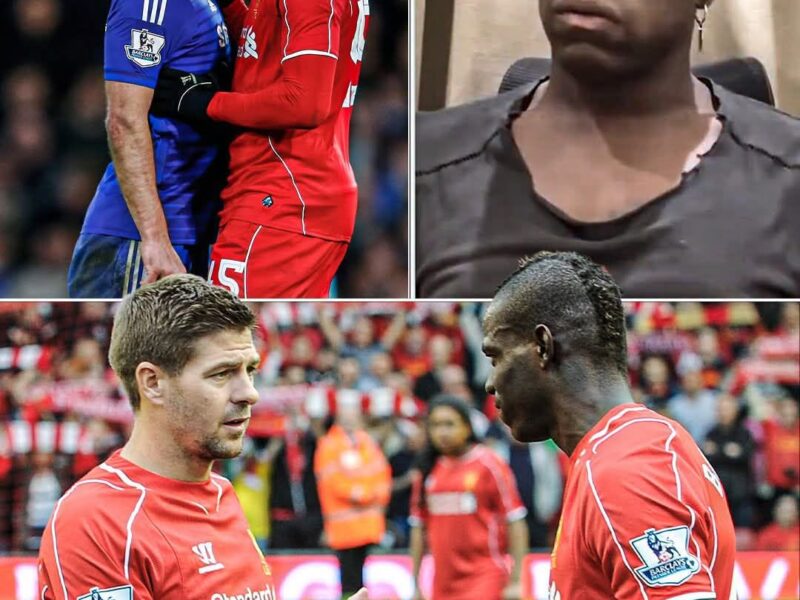
Mario Balotelli opens up about his difficult time at Liverpool: “Scoring goals is the hardest thing at Anfield.”
Some players join a big club with immense expectations, only to leave with a sense of regret.
Mario Balotelli is one such case.
When Liverpool signed Balotelli from AC Milan in the summer of 2014 for a fee of around £16 million, fans hoped the Italian striker would fill the void left by Luis Suárez. Liverpool had just come off an explosive season, finishing runners-up to Manchester City in the Premier League, so the pressure on Suárez’s successor was immense.
But at Anfield, things quickly became difficult.
It wasn’t that Balotelli lacked talent.
It wasn’t that he hadn’t proven he could score crucial goals.
The problem was that the goals everyone was waiting for simply didn’t come often enough.
Expectations were sky-high when Balotelli arrived at Anfield.
Balotelli was no unknown player.
He had played for Inter Milan, Manchester City, and AC Milan. He had won the Premier League, scored vital goals for the Italian national team, and commanded the world’s attention at Euro 2012.
So, when Liverpool brought him back to the Premier League, it wasn’t viewed as a minor gamble.
It was a signing that carried huge expectations.
Liverpool themselves had presented Balotelli as an experienced striker capable of making a difference.
But just weeks later, the questions began:
“When will Balotelli score?”
And Balotelli himself knew he was facing a problem.
In October 2014, early in the season, Balotelli admitted that his primary concern was scoring his first Premier League goal.
He said that while Liverpool fans adored him, he understood their potential disappointment at his failure to score in the league. At that time, Balotelli had already scored a Champions League goal against Ludogorets but had yet to open his account in the Premier League.
Notably, Balotelli did not deny the issue.
He admitted he needed to make more runs into the penalty area.
He also stated that he had never truly been an out-and-out striker; given the choice, he preferred playing alongside another forward rather than operating as a lone striker.
And that was precisely part of the reason why his time at Liverpool became complicated.
Was Balotelli not the type of striker Liverpool needed?
Under Brendan Rodgers, Liverpool required a player capable of applying constant pressure, moving ceaselessly, and arriving in the box at the right moment.
Balotelli, however, had different tendencies.
He liked to drop deep to receive the ball.
He enjoyed participating in the build-up play.
He preferred having space to work with.
And he did not always operate like a classic number 9.
Rodgers recognized this as well.
After Balotelli scored his first goal for Liverpool against Ludogorets, the Northern Irish manager emphasized that the striker needed to stay in the box more often, rather than frequently drifting wide to collect the ball.

It was a small detail, yet it spoke volumes.
Liverpool wanted Balotelli to be a type of striker with whom he himself did not feel entirely comfortable.
The first goal finally arrived.
September 16, 2014.
Anfield.
Champions League.
Ludogorets.
The 81st minute.
Balotelli received the ball inside the box, used his strength to hold off opposing defenders, and finished with the outside of his right foot into the far corner.
1-0 to Liverpool.
It was Balotelli’s first goal in a Liverpool shirt.
Rodgers praised his technique and ability to handle the ball, expressing his belief that the goal would help the Italian striker regain his confidence. But the problem remained.
He had yet to score in the Premier League.
And the pressure began to mount.
The Liverpool of that time was no longer the Liverpool of the previous season.
Suárez had left.
Daniel Sturridge was struggling with fitness issues.
Raheem Sterling was being used more frequently.
The attacking system had changed, too.
Meanwhile, Balotelli was tasked with playing as a lone striker.
It was a position he had explicitly stated he disliked.
By October, he was still searching for his first Premier League goal and admitted he had to learn to adapt to Rodgers’ demands.
Balotelli actually put in more effort than people realized.
This is an aspect often overlooked when discussing Balotelli’s failure at Liverpool.
Many remember his inconsistent performances.
But Balotelli insisted that he had never run as much as he did during that period.
In an interview with Fox Sports Australia, Balotelli rated his own performance more highly than before, explaining that it was because he was covering more ground.
He said the goals would come; they simply hadn’t arrived yet.
So, the story wasn’t simply:
“Balotelli wasn’t trying.”
It was more complex than that.
He was trying to adapt to a system that didn’t quite suit him.
But Liverpool needed goals, not just effort.
That was the issue.
A striker might run a lot.
He might battle for the ball.
He might link up well with teammates.
But ultimately, he is judged by the numbers on the scoreboard.
And Balotelli didn’t have enough of those numbers.
But elite football demands more than just talent.
You need the right system, the right timing, and stability.
Balotelli lacked those elements at Anfield.
Ultimately, his time at Liverpool was merely a sad chapter.
Balotelli left Liverpool on loan to AC Milan in 2015.
A year later, he parted ways with the club permanently to join Nice.
The Anfield adventure was over.
No flurry of goals.
No major trophies.
No fairytale ending as many had once imagined.
Only one question remained:
“What happened to Mario Balotelli?”
Perhaps the answer isn’t that he wasn’t good enough.
Maybe it was simply that Liverpool, at the time, wasn’t the right fit for him.
And that is the lesson of Balotelli’s story.
Some players fail because they lack the necessary quality.
But others fail because they never find the right environment for their talent to flourish.
Mario Balotelli’s time at Liverpool likely falls into the latter category—though he himself has admitted to bearing some responsibility.
He arrived at Anfield as a striker who had commanded the attention of all Europe.
He left with just four goals from 28 appearances.
Yet, between those two figures lies a story of pressure, tactics, adaptation, missed opportunities, and a player striving to rediscover himself.
And perhaps the most painful part for Balotelli wasn’t his failure to score enough goals.
It was never having the genuine chance to become the player Liverpool fans had hoped for.
Because sometimes in football, talent alone isn’t enough.
You need a system that suits you.
You need belief.
You need time.
And above all…
You need to be in the right place to truly be yourself. 🔴⚽