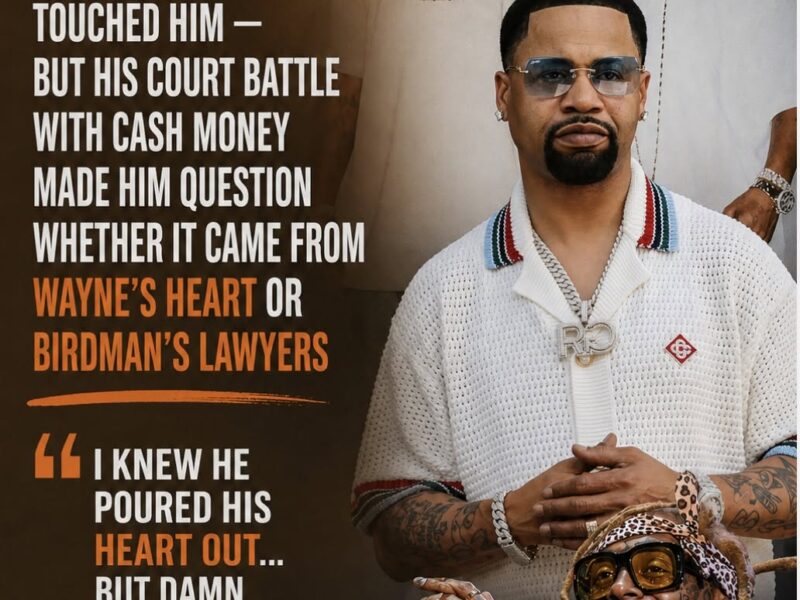
Juvenile Says Lil Wayne’s “I Miss My Dawgs” Touched Him — But Their Court Battle With Cash Money Made Him Question Whether It Came From Wayne’s Heart or Cash Money Lawyers
Some songs are written purely for entertainment, while others inadvertently become part of far more complex real-life narratives. For Juvenile, Lil Wayne’s “I Miss My Dawgs” was one such case.
The rapper admitted that listening to the track stirred deep emotions in him. However, at the time of the song’s release, his relationship with Cash Money was overshadowed by legal disputes and financial issues. This context left him unsure of how to receive Lil Wayne’s heartfelt words.
Juvenile explained that he felt he was receiving mixed signals. On one hand, he heard genuine emotion from a younger artist with whom he had once been close. On the other, he could not entirely set aside the ongoing legal battles.
A song that left Juvenile both moved and skeptical
Lil Wayne performed “I Miss My Dawgs” as an expression of longing for those who had once walked the path alongside him. For Juvenile, those words resonated with a genuine, real-life relationship.
He stated that he was truly touched by what Wayne conveyed in the song.
Yet, the circumstances led Juvenile to question the situation: were these words truly from Lil Wayne’s heart, or were there ulterior motives at play?
Reflecting on that time, Juvenile recalled wondering whether the song’s message came entirely from Wayne or if it was influenced by the people behind the scenes at Cash Money.
This question was not a denial of the bond between the two artists. Rather, it reflected the state of mind of someone caught between two worlds: the brotherhood they shared and the conflicts regarding business and money.
“I know Wayne put his heart into it”
Notably, Juvenile never denied the sincerity of Lil Wayne’s emotions.
On the contrary, he acknowledged that he knew Wayne had truly poured his feelings into the track. It was precisely this realization that placed Juvenile in such a difficult position. He might have been touched by Wayne’s words, but that didn’t mean his financial and entitlement issues would simply vanish.
This was the very conflict Juvenile had to face.
How could one simultaneously miss a brother and continue to fight for the money one believed was rightfully owed?
For Juvenile, those two emotions could—and did—coexist.
He once described his state of mind quite candidly: he knew Wayne was sincere, yet he still had to ask himself whether he should walk away from what he considered his own.
“I miss my dog… I miss my royalty.”
Perhaps the statement that best captures Juvenile’s inner conflict is simply:
“I do miss my dog… I miss my royalty.”
A single sentence that encapsulates almost the entire story.
Juvenile never denied his affection for Lil Wayne, nor did he deny that their years together at Cash Money were a pivotal part of their journey.
Yet, sentiment cannot replace matters of professional rights and compensation.
For an artist, royalties, contracts, and music ownership represent more than just money; they signify recognition of their hard work and contributions throughout their careers.
Disputes complicate the bond of brotherhood.
The relationship between Juvenile, Lil Wayne, and Cash Money is inextricably linked to a crucial era in Southern hip-hop.
Cash Money served as the launchpad that propelled numerous New Orleans artists to stardom. Juvenile, Lil Wayne, and others collectively defined a remarkable chapter in the label’s history.
However, immense success also brought complications regarding contracts, finances, and rights. That is why Juvenile couldn’t simply listen to “I Miss My Dawgs” and brush aside everything else that was going on.
Had the song come out during ordinary times, he might have simply heard it as an expression of longing from a close younger brother figure.
But appearing amidst ongoing disputes, the situation became far more complicated.
In hindsight, Juvenile believes Wayne might have come to understand him better.
The most interesting aspect of Juvenile’s reflection is how he views the story years later.

According to Juvenile, Lil Wayne eventually faced his own business-related disputes and hardships. Consequently, he believes Wayne likely gained a better understanding of what Juvenile had gone through.
Juvenile even imagines Wayne might have thought:
“Damn, I feel what dude was going through now.”
Translation: “Now I understand what he was going through.”
If so, this marks a significant shift in perspective for both artists.
In their youth, issues regarding contracts and money could strain their friendship. Yet, as one matures and experiences similar situations firsthand, one might begin to look back at the past from a completely different angle.
Balancing brotherhood and money is never easy.
The story of Juvenile and Lil Wayne reveals the complex reality behind the music industry.
The two may genuinely love and cherish one another, yet that does not mean business issues simply vanish.
Juvenile might feel moved when hearing Wayne speak of their brotherhood, while simultaneously feeling entitled to question royalty payments and what he believes he is owed.
These sentiments are not necessarily contradictory.
At times, one can miss a friend while remaining dissatisfied with how their professional dealings unfolded.
And perhaps that is precisely why “I Miss My Dawgs” holds such special significance for Juvenile.
It reminds him of his younger counterpart, the years gone by, and the bond they once shared. Yet, it also brings to mind the conflicts he cannot simply forget.
Ultimately, the story is about more than just a song.
It is about friendship, loyalty, money, entitlements, and the relationships that can become complicated when art transforms into business.
And years later, Juvenile seems able to say both things at once:
He misses his brother—but he also remembers what he believes he deserves.