Fans Debate: Drake Likened to a “Male Ice Spice” and Criticized for His Rap Style on New Track
Drake has once again found himself at the center of a social media debate, though this time it isn’t due to a new record or a blockbuster collaboration.
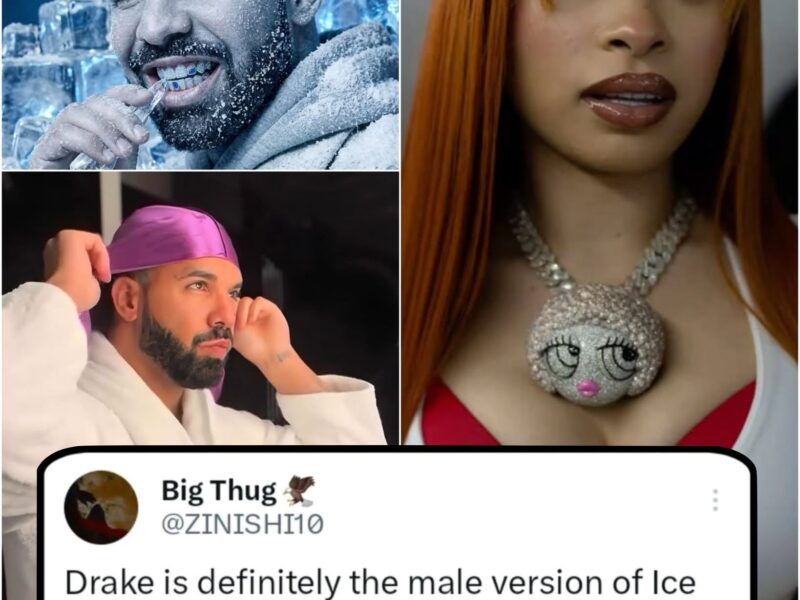
Some fans and critics are taking aim at his style on the track “ICEMAN,” even drawing a rather harsh comparison: that Drake is becoming the male version of Ice Spice.
It might sound like a joke.
But online, it quickly escalated into a serious debate about whether Drake is still truly “rapping” in the way audiences have come to expect.
“Is Drake not rapping anymore?”
Critics argue that his performance on “ICEMAN” lacks the elements they’ve long associated with him: wordplay, punchlines, storytelling, and the ability to switch up his flow.
For this group, the issue isn’t that Drake *can’t* rap.
The problem is that they feel he isn’t utilizing those skills enough in the song.
Instead, his vocals, phrasing, and rhythm remind them of Ice Spice’s style.
Hence the viral quip:
“Drake is the male version of Ice Spice.”
This is clearly more of a dig than an objective musical critique.
Yet, it highlights just how high public expectations for Drake are.
Why is Drake always under such intense scrutiny?
Drake is no ordinary artist.
For over a decade, he has cultivated an image as one of the most versatile rappers, capable of seamlessly shifting between rap and melodic music.
He can rap.
He can sing.
He can churn out radio hits.
He can craft emotionally resonant tracks.
And most importantly, Drake once convinced audiences that he could step into almost any style and make it his own. Consequently, when a new release is perceived by some listeners as lacking “rap” elements, the reaction is immediately more intense.
If a newcomer were to do the same, the debate likely wouldn’t be nearly as heated.
But when it involves Drake, everything comes under intense scrutiny.
Comparisons to Ice Spice
Dragging Ice Spice into the conversation has further fueled the buzz around “ICEMAN.”
Ice Spice is known for her minimalist rap style, signature rhythms, and unique delivery. She rose to prominence among the new generation of rappers thanks to her knack for creating instantly recognizable, viral-ready tracks.
Critics of “ICEMAN” argue that Drake relies too heavily on this similar approach, rather than showcasing the lyrical prowess they expect from him.
However, claiming Drake “isn’t rapping” simply because he employs a melodic or minimalist style is a judgment that warrants caution.
There is no single way to rap.
A rapper doesn’t necessarily need complex flows or a barrage of punchlines to qualify as rapping.
What matters more is the artist’s intent behind the track.
“Delete the song” — when the debate goes beyond the music
Some harsh comments even demanded that Drake delete the track, dismissing it as nothing more than “noise pollution.”
This is a typical reaction when dealing with a superstar artist.
Listeners don’t just say they dislike the song.
They want the artist to admit that the song is bad.
But music doesn’t work that way.
A single track can be fiercely hated by one group while being loved by another.
This is especially true for Drake.
His career has been built on the ability to craft songs that appeal to diverse audiences. Some tracks are highly praised for their lyricism, while others are simpler, focusing instead on vibe, melody, or catchiness.
Is “ICEMAN” actually trash?
There is no definitive answer to that question.
If you were expecting a verse reminiscent of the *Take Care* or *Nothing Was the Same* eras—or the razor-sharp rapping that originally built his reputation—you might well be disappointed.
However, if the song’s goal was to create a different atmosphere through a minimalist approach and viral appeal, the fact that it differs from Drake’s traditional rap output doesn’t mean it lacks value.
An artist has the right to evolve.

And the audience has the right to dislike that evolution.
Drake and the pressure to constantly prove he’s still a rapper
This is perhaps the most interesting part of the story.
Drake has reached a level of fame where every release is inevitably measured against his past achievements.
If he raps with technical complexity, people say he’s trying too hard to prove himself.
If he sings a lot, people say he’s stopped rapping.
If he makes catchy music, people say he’s chasing TikTok trends.
If he experiments, people say he’s losing his essence.
In short:
It is virtually impossible for Drake to please everyone.
His massive fame ensures that even the slightest stylistic shift becomes a subject of debate.
A single comment can spark a massive argument.
“Drake is the male version of Ice Spice” might just be an online quip.
But it reflects a very real aspect of modern hip-hop culture:
Audiences increasingly demand that artists possess a distinct identity.
When Drake experiments, listeners immediately make comparisons.
When he switches up his flow, they analyze it.
When he doesn’t deliver punchlines like he used to, they question whether he’s still a “real” rapper.
That is the price of being one of the biggest names in hip-hop history.
An unknown artist could release a terrible song, and no one would care.
But Drake is different.
A new track from him can generate thousands of comments in just a few hours.
And even those who claim to hate the song are helping keep the conversation going.
Perhaps that is the greatest paradox of all.
You might call “ICEMAN” trash. You might say Drake isn’t rapping anymore. You might compare him to Ice Spice.
But if all of that keeps people talking about Drake, then he is still achieving something very few artists can:
Turning a song into a conversation.
As for whether “ICEMAN” is actually good?
Ultimately, the answer lies in the listener’s ears. 🎤