‘Faith Will Be Rewarded!’ 15 Milestones In Springsteen’s Life That Led to the Land of Hope and Dreams Tour
Bruce Springsteen has been on the most important tour of his career.
Not a globe-circling, stadium-packing, box-office-busting run like those of past years. But a nine-week sweep across the United States to guard the dreams and visions of a troubled nation and to prove the power of art to move hearts and minds.
“The E Street Band is here tonight,” says Springsteen, introducing these shows, “in celebration and defense of the American ideals and values that have sustained our country for 250 years.
“We are here to call upon the righteous power of art, of music, of rock’n’roll in these dangerous times.
“Our democracy, our Constitution, our rule of law are being challenged right now as never before by a reckless, racist, incompetent, treasonous president and his ship-of-fools administration.”
He presses his case further in comments mid-show, recounting the offenses, at home and abroad, of the Trump presidency. “This is happening now,” he declares after each indictment.
The Land of Hope And Dreams Tour brings its truth to the power center of Washington D.C. on Wednesday (May 27) for a penultimate show at Nationals Park. (The D.C. show is preceded by two remaining tour stops May 22 in Cleveland and May 24 in Boston, with a finale on a rescheduled date in Philadelphia May 30).
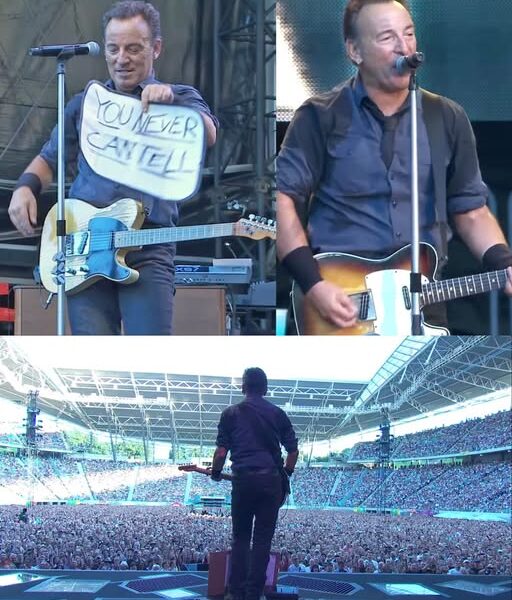
These performances — as witnessed by this writer at the UBS Arena in Elmont, N.Y., on May 5, at the Barclays Center in Brooklyn on May 14 and at Manhattan’s Madison Square Garden on May 16 — find the E Street Band playing at their peak, with rolling waves of sound pounding like a storm on the Jersey coast.
But as important, every song on this tour evokes a milestone on Springsteen’s lifelong journey to this moment. The Land of Hope And Dreams Tour is, in fact, a potent distillation of Springsteen’s career and life.
It is a life that began with learning right from wrong….
1
“They Did Their Work Hard and They Did It Well”
The greatest influence on Springsteen’s life and work has not been not the Beatles or Bob Dylan or Woody Guthrie. It is Adele Springsteen, his Brooklyn-born mother, the emotional center to his tumultuous childhood. A proud working citizen of Freehold, N.J., she found endless joy in dancing, “the embodiment of who she is,” Springsteen wrote upon Adele’s death in 2024 at age 98.
But also, just up Randolph Street from Springsteen’s first home was St. Rose of Lima Church. During the performances of Springsteen on Broadway filmed for Netflix in 2018, the singer recalled trips back to that street to “commune with the old spirits” of family members now gone.
“Once again, I stood in the shadow of my old church,” he says. “You know what they say about Catholics… yeah, there’s no getting out. Nah, nah, you know they got you. They got you. The bastards got you when the getting was good. They did their work hard and they did it well.”
2
“This Land Is Your Land”
How does someone come to deeply love their country? By seeing it, all of those wheat fields waving and dust clouds rolling, mile after mile, town to town. From Woody Guthrie to Jack Kerouac to Bruce Springsteen, and for countless others, the emotional impact of traveling overland between the East Coast and California, particularly as a young person, cannot be overstated.
Long before his arena and stadium tours, three years before the release of his debut album Greetings from Asbury Park, Springsteen journeyed with his band Steel Mill and manager Tinker West, from New Jersey to California, for a New Year’s Eve gig in the unlikely setting of the Esalen Institute, in the mountains of Big Sur on the Pacific coast.
Recalling the trip decades later, in his memoir, he declares simply, “The country was beautiful.”
3
“War Means Tears to Thousands of Mother’s Eyes”
“We begin tonight with a prayer for our men and women in service overseas,” says Springsteen to open each of these shows. “We pray for an end to the conflict and for their safe return.
“Tonight… we ask all of you to join with us in choosing hope over fear, democracy over authoritarianism, the rule of law over lawlessness, ethics over unbridled corruption, resistance over complacency, truth over lies, unity over division and peace over..
“WAR!” he howls, as the arena explodes with light and the E Street Band’s cover of Edwin Starr’s classic. “War” topped the Billboard Hot 100 for three weeks in the summer of 1970. Only weeks earlier, on May 4, 1970, four college students protesting the war at Kent State University were shot to death by members of the Ohio National Guard. Springsteen opens his set with this song that evokes another era when musicians responded to atrocities of the times.
4
“I’m Forty Years Burning Down the Road”
If … Springsteen had not stopped for gas outside of Phoenix on a cross-country drive in 1981 and randomly picked up the memoir of paralyzed Vietnam veteran Ron Kovic, Born On The Fourth of July; if, astonishingly, he had not then encountered Kovic, sitting poolside in his wheelchair, at the Sunset Marquis hotel in L.A. a few days later; if he had not accepted Kovic’s invitation to meet with other Vietnam vets — then Springsteen might not have written “Born in the U.S.A.,” the anthem that defined his `80s superstardom and ignited his activism.
“War” and “Born in the U.S.A” now deliver the opening one-two punch of a tour set that is simply relentless as it rocks through the Celtic march of “Death to My Hometown” (“Send the robber barons straight to hell”); the punk-rock energy of the Clash’s “Clampdown” (“In these days of evil presidentes!”), the soaring harmonies of “No Surrender” (“Like soldiers in the winter’s night/ With a vow to defend”), and “Darkness On The Edge of Town” (“Tonight I’ll be on that hill `cause I can’t stop”).
5
“ICE Out Now!”
Consider this musical lineage: Woody Guthrie’s “Deportees (Plane Wreck at Los Gatos),” Pete Seeger’s “Waist Deep in the Big Muddy,” Bob Dylan’s “The Lonesome Death of Hattie Carroll,” Phil Ochs’ “I Ain’t a Marching Anymore” — all classics written off the headlines of their time.
Springsteen offers up “Streets of Minneapolis” in that great tradition of topical songwriting. He played it live for the first time at A Concert of Solidarity & Resistance to Defend Minnesota!, organized by Tom Morello Jan. 30 at the First Avenue Club in Minneapolis.
“ICE Out Now!” he now shouts along with the crowd, three times, the house lights blazing on with each repetition, as he sings: “There were bloody footprints/ Where mercy should have stood/ Two left to die on snow-filled streets/ Alex Pretti and Renée Good.”
6
“Lace Up Your Dancing Shoes”
Springsteen would never have had the same impact on popular culture of the past four-plus decades if not for, well, his hits. Nor would the outrage of the Land of Hope and Dreams Tour be as effective without the pure joy brought by the evening’s performances of “Hungry Heart” — Springsteen’s first Hot 100 top 5 hit, from The River album in 1980 — and the sweet romanticism of “Two Hearts,” from the same album. Later, during an encore, fans mimic the goofy dancing of Springsteen’s first video during the band’s performance of early MTV-era smash ”Dancing in the Dark.”
During Springsteen on Broadway, here’s how he introduces that song: “Remember that the future is not yet written… So when things look dark, do as my mighty mom would insist, lace up your dancing shoes and get to work.”
7
“Fed My Children and Made My Pay”
During Springsteen’s childhood, among the jobs held sporadically by his father, Douglas, was as a laborer at the former Karagheusian Rug Mill in Freehold. The plant shut down in 1964, after providing financial security to the town’s families for 60 years.
Today, among Springsteen’s white-collar fans, job losses are more likely to stem from the corporate adoption of AI programs — more than 135,000 AI-related layoffs since January 2025, by one estimate. Companies have begun to cut employee benefits to pay for AI expansion, Axios reports.
The nation’s long history of economic violence against its workers stokes the fire of “Youngstown,” which Springsteen and the E Street Band perform with ferocity.
“Now sir, you tell me the world’s changed,” roars Springsteen, “Once I made you rich enough/ Rich enough to forget my name.”
8
“Promise Mama You’ll Keep Your Hands In Sight”
Before George Floyd, there was Amadou Diallo. It was Feb. 4, 1999. Diallo, an unarmed, 23-year-old West Indian student, was confronted by four plainclothes policemen who were searching for a serial rapist in the Soundview section of the Bronx. In the doorway of his apartment building, Diallo reached for his wallet. The officers believed he was going for a gun — and they fired, again and again.
“41 shots, 41 shots,” Springsteen and his backup singers intone in “American Skin (41 Shots),” an mournful, essential addition to this tour’s national portrait.
Even as Springsteen sought to offer the perspective of the police (“You’re kneeling over his body in the vestibule/ Praying for his life”), in his memoir he writes:
“No other song I’d written, including ‘Born in the U.S.A.’ ever received as confused and controversial a reaction as ‘American Skin.’ It truly pissed people off. It was the first song where I stepped directly into the divide of race, and in America, to this day, race cuts deep.”
9
“Tryna Figure Out What Went Wrong”
A native son returns to his hometown where, from the barbershop to the grocery store, he is viewed as a stranger. The veterans hall stands “silent and alone;” a diner “was shuttered and boarded/ with a sign that just said, “Gone.’”
Released in 2007 during the presidency of George W. Bush, Springsteen’s “Long Walk Home” describes the heartbreaking divide many have felt between loved ones, neighbors and fellow citizens, as the country has grown only more politically polarized over the past two decades.
“This is a prayer for our country,” says Springsteen as he performs “Long Walk Home” now, to make a statement about enduring national values. As the Stars and Stripes are projected briefly above the crowd, he sings: “Your flag flying over the courthouse/ Means certain things are set in stone/ Who we are, what we’ll do and what we won’t.”
10
“Come on Up, Lay Your Hands in Mine”
Across the New York area, it was a spectacularly beautiful autumn day with a cloudless blue sky. Sept. 11, 2001. Learning of the attacks on the World Trade Center, Springsteen drove out to the Rumson-Sea Bright Bridge where, he writes in his memoir, “torrents of smoke lifted from the end of Manhattan Island, a mere fifteen miles away, by boat.
“Just then” he writes, “a car careening off Rumson-Sea Bright Bridge shot past, its window down, and its driver, recognizing me, shouted, ‘Bruce, we need you.’ I sort of knew what he meant, but…”
“The Rising,” the title track from Springsteen’s album in response to 9/11, has been in the set list of this tour since opening night in Minneapolis on March 31. But at New York area shows, the song just hits differently, more vividly, more painfully, still.
In the voice of a firefighter climbing the towers, Springsteen sings: “A dream of life comes to me/ Like a catfish dancing on the end of the line.”
11
“Shelter Line Stretching Around the Corner”
Tom Morello first joined Springsteen and the E Street Band for a pair of shows in Anaheim, California, in 2008, a decade after Morello’s band Rage Against the Machine created an uncompromising rap-rock cover of “The Ghost of Tom Joad.” The two have collaborated and played live together periodically since.
Morello’s searing, screeching, wailing guitar solo on “The Ghost of Tom Joad” makes this tour’s version of the song unforgettable.
“Shelter line stretching around the corner/ Welcome to the new world order,” they sing. “Families sleeping in cards in the Southwest/ No home, no job, no peace, no rest.”
On stage now, Morello’s guitar is emblazoned with three words: “Arm the Homeless.”
12
“You’ll Need a Good Companion For This Part of the Ride”
For all the outrage and anger which has fueled Springsteen’s return to the road this spring, the tour is very pointedly about hope and dreams. And the tour’s stirring title song is rooted in Springsteen’s rebuilding of community, beginning with the E Street Band.
On March 11, 1999, the E Street Band gathered at the Convention Hall in Asbury Park to rehearse for its first major tour together in a decade. The day before that tour opened, in Barcelona on April 9, 1999, Springsteen recalls in his memoir, he introduced the band to the new song “Land of Hope And Dreams.”
The song “summed up a lot of what I wanted our band to be about and renewed our pledge to our audience, to point the way forward and, once again, become a living presence in our listener’s lives.”
“Land of Hope and Dreams” has far surpassed Springsteen’s goals — and become, in this moment, an inspiring new American anthem.
13
“When Scooter and the Big Man Bust This City In Half”
“Tenth Avenue Freeze-Out” is the horn-powered, house-lights-on, show’s-not-quite-over celebration of the musical magic created across the decades by Springsteen and his late saxophonist Clarence Clemons. It is the partnership captured in the iconic album cover photo for Born To Run, with the scraggly white rocker leaning on his imposing Black sideman. Their lifelong friendship, across racial barriers, symbolized the true, yet still-elusive, runaway American dream of Springsteen’s music.
“Since the inception of our band it’s been our ambition to play for everyone,” writes Springsteen in his memoir. “We’ve achieved a lot, but we haven’t achieved that. Our audience remains tribal… that is, predominantly white. On occasion — the Obama inaugural concert; touring through Africa in 1988; during a political campaign, particularly in Cleveland with President Obama, I looked out and sang `Promised Land’ to the audience in intended it for, young people, old people, black, white, brown, cutting across religious and class lines.”
14
“For Each Unharmful Gentle Soul Misplaced Inside a Jail”
On July 3, 1988, during a global radio broadcast from Stockholm, Springsteen announced his participation — along with Sting, Peter Gabriel, Tracy Chapman and Youssou N’Dour — in the multi-continent Human Rights Now! Tour, to draw attention to the work of Amnesty International and the 40th anniversary of the Declaration of Human Rights.
Amnesty International, which has long focused on regimes overseas, has also catalogued human rights violations in the United States, including “unprecedented number of actions undermining the rule of law.”
During that summer performance in 1988, as the music of the E Street Band swelled beautifully behind him, Springsteen concluded the announcement on that summer’s day by singing Bob Dylan’s “Chimes of Freedom.”
Springsteen is now closing shows on the Land of Hope and Dreams Tour with the same song. And it could not be more apt, with the detention of some 400,000 immigrants during the second Trump term.
“And for each unharmful, gentle soul misplaced inside a jail,” Springsteen sings, “and we gazed upon the chimes of freedom flashing.”
15
“Go Out And Get Into ‘Good Trouble.’”
Springsteen sits on the edge of the stage, holding his well-traveled guitar on his lap, as organ chords play softly behind him, for the evening’s closing prayer, before the performance of “Chimes of Freedom.” A recounting here cannot do justice to his cadence of his comments. But his words are worth sharing in full.
“The E Street Band was built for hard times,” he says. “And we will make it through this. Because with the love and the fight and the spirit and the faith and the hope in your heart, America renews itself.
“I think the hardest part for me has been feeling that distance between you and your neighbors, between you and your fellow citizens. That distance can darken your soul.
“Now we have a president who says he wishes nothing but ill, upon those who he disagrees with. That’s not the country I want to live in.
“From the beginning, America was born out of disagreement. It’s an argument. It’s supposed to be an ongoing, blessed, sacred argument about what course the country should take to form that more perfect union. We can argue about these things, while still recognizing our common humanity, our dignity, and yes our unity.
“The most heart-breaking example of this was Renée Good’s last words. She rolled down the window. And she looked at the man who only minutes later would kill her, would take her life, and she said to him, ‘I’m not mad at you. I’m not mad at you.’
“God bless her.
“When you go home tonight, hold your loved ones close. And in the morning, do as Renée did, find a way to take aggressive, peaceful action to defend our country’s ideals.
“And as the great civil rights leader John Lewis said, go on out and get into some `good trouble.’
“Say something! Do something!” Springsteen then exclaims, adding with a touch of self-mockery, “SING something! That’s all I do.”
“If you feel helpless, hopeless, angry, frustrated, betrayed, I understand. That’s why we’re here tonight.. We needed to see and feel your strength and your hope. And we needed to bring you some hope and some faith and some strength.
“I hope we did that tonight.”