“Can I Eat Your Leftovers?” — a Poor Girl Asked a Mafia Boss… and Everything Changed
That night, the city glowed with lights—lights that brought warmth to some and felt cold to others.
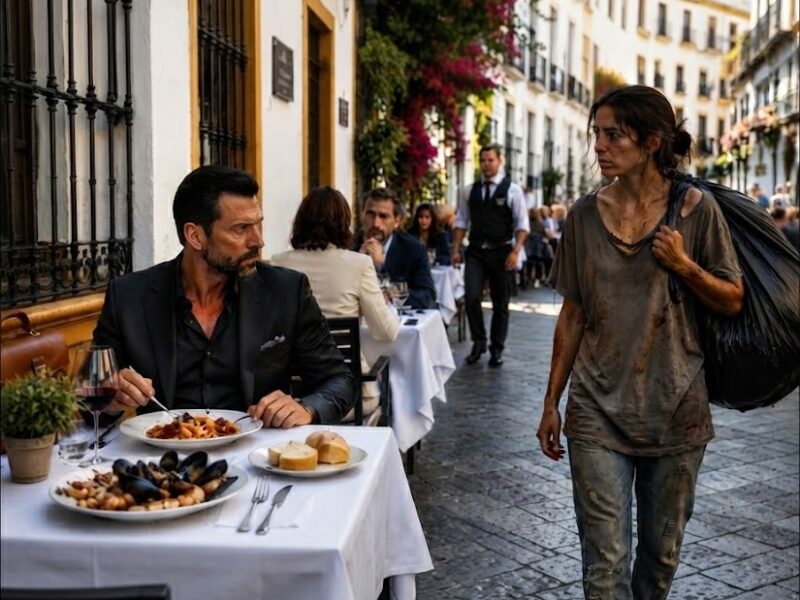
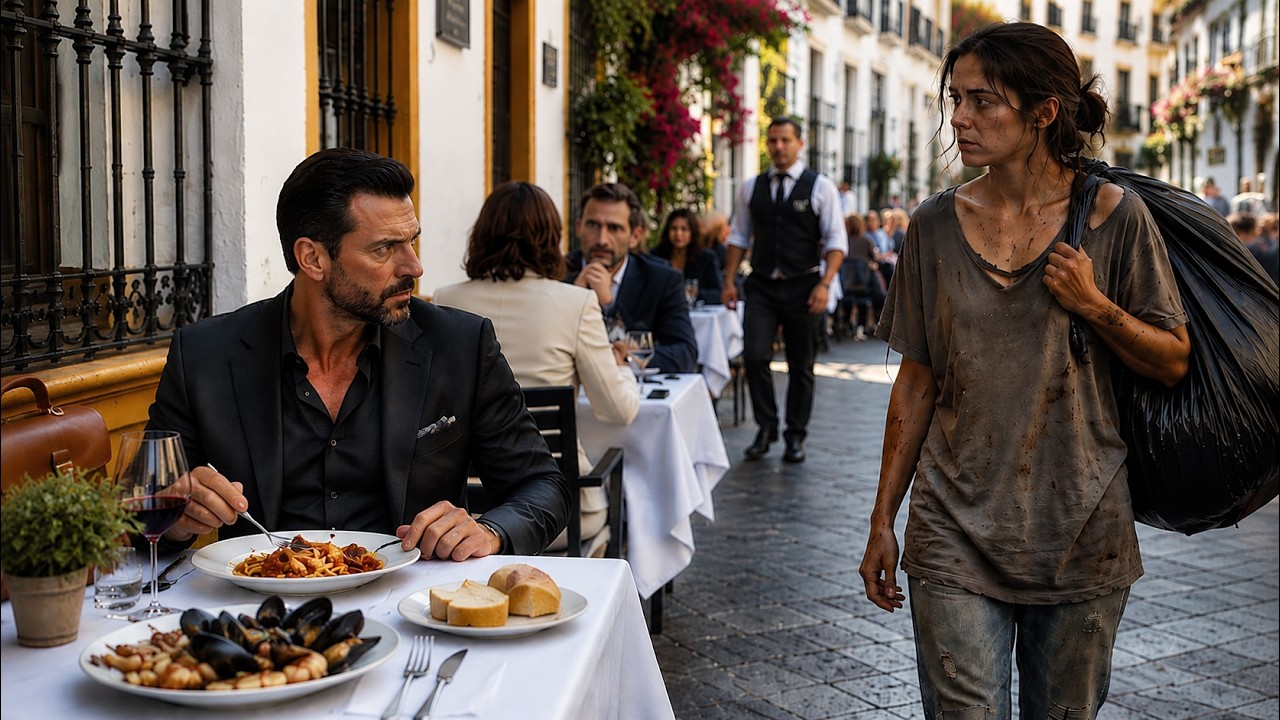
Lena stood quietly outside a luxury restaurant, watching people laugh and talk through the glass walls while trying to ignore the emptiness in her stomach.
Her shift at the small café had ended hours ago. But going home brought no relief, because home meant a nearly empty kitchen and a younger brother who always pretended he wasn’t hungry.
Her mother kept telling her to be strong, but strength did not solve everything. Sometimes it only dulled hunger—it didn’t erase it.
She stood near the alley behind the restaurant where leftover food was sometimes discarded, patiently waiting. She had learned not to feel ashamed of surviving like this anymore.
After a few minutes, the restaurant door opened and a waiter stepped out carrying a bag of leftovers.
Lena’s heart tightened as she moved forward—but before she could fully step out, she noticed him.
A man standing near the entrance, not quite looking like a customer or staff.
Tall, wearing a perfectly tailored black suit, calm yet heavy with presence. In some way, everything around him seemed controlled.
His face was unreadable, his eyes sharp and observant. And although he did nothing threatening, people around him moved carefully, as if even the space around him obeyed different rules.
Lena didn’t know who he was.
But something about him made her hesitate for a moment before she still stepped forward.
She asked quietly if she could take the leftovers.
As soon as she spoke, the atmosphere shifted slightly.
The man slowly turned his head toward her, his gaze locking onto her as if she were something unexpected in his world.
Lena immediately felt self-conscious and quickly tried to explain—saying she hadn’t eaten all day and could pay later—but she stopped halfway, realizing how untrue that sounded.
A heavy, strange silence settled between them.
The man looked at her closely—not casually, but deeply, as if trying to understand her situation without words.
Then he simply asked why she didn’t eat at home.
Lena hesitated, then honestly admitted that sometimes there was no food at home.
That answer made the atmosphere even heavier, quieter—as if even the city noise dimmed for a moment.
The man looked at the bag of leftovers in the waiter’s hand, then back at her.
Without raising his voice or showing emotion, he told the waiter to give it to her.
The waiter froze briefly, confused, but obeyed.
The bag was handed to Lena.
She held it carefully, as if not believing it was real, and asked if he was sure.
But the man was no longer looking at her.
He simply said it was just food—nothing more.
To him, it meant nothing.
But to her, it meant everything.
Lena stood there holding the bag, still unable to understand why something so small felt like it had changed how the world saw her.
Behind her, the man in the black suit watched her for a moment longer before turning away.
Unaware that this simple encounter was about to become the beginning of something neither of them could ignore.
She clutched the bag as if it were something she wasn’t allowed to have—something too rare in her life to accept easily.
Her fingers tightened around the plastic as she slowly walked away, still feeling the weight of his gaze even though he was no longer looking at her.
She didn’t understand why, but that moment felt different from everything else in her life—as if a small crack had formed in her reality.
Life continued as usual, but something unfamiliar had begun to seep in.
That night, her younger brother’s smile when he saw the food made her chest tighten.
Her mother said nothing, but the look she gave Lena carried unspoken questions.
Lena simply said it was leftover food from work and avoided further explanation.
All evening, she replayed that moment in her mind—especially the man’s eyes.
Not pity. Not judgment.
Something closer to curiosity… and control, as if he was trying to understand her.
The next morning began like any other—busy, tiring.
But by midday, something strange happened.
The street outside the café became unusually quiet.
Then came the black cars.
One. Then another. Then another.
Three black SUVs parked outside in a perfect line.
Lena felt her movements pause as she stared from inside the café.
Something was wrong.
And then the door opened.
He stepped out.
The same man from the night before.
Same black suit. Same calm expression. Same controlled presence.
But this time, he was not alone.
Two men in suits followed behind him.
Lena instinctively stepped back from the window, trying to process what was happening.
Why was he here?
Why outside her café?
She hadn’t done anything wrong.
The café door opened.
A bell rang.
And the room fell silent.
He walked in calmly, as if he owned the space.
His eyes scanned the café once—then locked directly onto Lena.
And then he walked toward her.
Each step made the room quieter.
When he reached the counter, he stopped.
“I remember yesterday,” he said calmly.
Lena blinked, confused.
He continued: he had been looking for her since the previous night.
That immediately unsettled her.
She asked why he was looking for her when she had only taken leftovers.
He replied simply that it wasn’t about the food.
That made the air feel heavier.
Lena crossed her arms. “What do you want from me?”
He paused, studying her.
Then he said his name was Adrien.
And the moment he said it, someone in the café whispered in fear.
Lena noticed.
And something in her perception shifted.
Adrien explained that the food she had taken belonged to his family’s restaurant network.
Lena frowned, saying she didn’t understand any system—she only needed food.
That response made him pause.
For the first time, his expression changed slightly—not anger, but curiosity.
As if she was not what he expected.
One of the guards moved forward, but Adrien stopped him with a small gesture.
Lena noticed that too.
He wasn’t just a man.
He was someone people obeyed without question.
The café manager rushed over nervously, but Adrien ignored him completely.
His attention stayed on Lena.
He asked if she always did this.
Lena replied honestly: if she had enough money, she wouldn’t need to take leftovers.
That answer changed something in him again.
A long silence followed.
Then Adrien said she didn’t need to take leftovers anymore.
Lena frowned.
He explained that if she was hungry, she could come directly there instead of hiding in alleys.
Lena asked why he cared.
For the first time, Adrien hesitated slightly.
Then he said it was not normal for someone to ask for food like that.
Not with pride.
Not with expectation.
Just honesty.
That made Lena look away, uncomfortable.
But what she didn’t notice was how he kept watching her—like she reminded him of something long forgotten.
Something he had not yet understood.
And in that moment, standing inside a quiet café, Lena had no idea that a simple request for leftovers had pulled her into a world where kindness was never simple—and being noticed by someone like him was never accidental.
What had happened had already happened.
“Are you following me now?” she asked, looking confused. Adrienne looked at her.
“No, I just stopped for a moment. I just wanted to make sure you…”
“I’ve already made it home,” Lena said softly, shaking her head. “You don’t even really understand me.”
Adrienne’s voice lowered slightly. “I know enough not to ignore you.”
That sentence made her fall silent. For the first time, Lena realized something was no longer normal. This wasn’t just…
A man occasionally visiting a café. This was something deeper—something connected, dangerous, something she still didn’t fully understand.
And Adrienne, standing on that quiet street, knew one thing clearly: he was no longer just an observer of her life. He was becoming part of it.
After that night, Lena couldn’t sleep well anymore. Every time she closed her eyes, she kept seeing the same image repeating over and over.
Adrienne standing between her and those two men, calm and unshaken, as if danger itself had to stop and think before acting.
She approached him. She told herself it was nothing—just a coincidence, just a stranger helping at the right time. But deep down, she felt…
She knew things were becoming more complicated than she wanted to admit.
The next morning, she went to work as usual, but her mind was no longer at the café. Every small sound outside made her…
She looked up. Every black car passing by made her heart tighten for a moment.
Jenna noticed Lena seemed distracted and asked if she was okay, but Lena only smiled and said she was tired.
Around noon, something unusual happened.
The café door opened, and instead of a customer, Adrienne walked in. But this time, everything felt different.
He didn’t sit down immediately, didn’t order anything, and didn’t even look around as usual. He walked straight…
Straight toward Lena and stopped at her counter. His expression was more serious than before. And for a moment, Lena felt that familiar tension.
“You need to be careful,” he said simply.
Lena frowned slightly. “Careful about what? My job? My coffee machine?”
Adrienne didn’t react to her sarcasm. Instead, he leaned in slightly.
“Those men from last night weren’t random.”
That immediately changed her expression. “I don’t even know those people,” she quickly replied.
“Now they know you,” he said.
“Why would anyone care?” Lena said, crossing her arms. “And what about me? I just work at a café.”
Adrienne looked at her for a moment, as if deciding how much to say.
“The issue isn’t who you are,” he said slowly. “It’s who has noticed you.”
Lena shook her head. This was starting to feel like a movie she never agreed to be in.
“You’re in it,” Adrienne said calmly.
That made her go silent for a moment.
That evening, Adrienne didn’t leave right away. He stayed longer than usual, sitting nearby.
Lena stood by the window, watching him. She noticed it, but said nothing. His presence no longer felt like an intrusion, but like a quiet form of protection, though she still didn’t fully trust what was happening.
When the café was about to close, Adrienne stood up and walked toward her again.
“I’ll take you home,” he said.
Lena immediately shook her head. “No, you don’t need to. You were being followed yesterday.”
“I’m fine. You’re not,” he said calmly.
That made her pause. His voice carried no argument—only certainty.
Lena sighed. “You’re so stubborn.”
In the end, she agreed.
Outside, the night air was quiet and colder than usual. Adrienne’s car was waiting—black and silent, as always.
Lena got in, still confused, still not understanding why this man kept inserting himself into her life.
As the car moved, silence filled the space between them.
This time, Lena didn’t feel as uncomfortable.
“Why are you doing this?” she asked quietly.
“Because I know what happens when people like you get noticed,” Adrienne said.
“People like me?” she frowned.
“People who help without being asked,” he replied.
“That wasn’t me,” she said.
“Nothing about it is special,” she added.
Adrienne finally turned slightly toward her.
“That’s exactly why it is.”
The car stopped near her street.
Before getting out, Lena hesitated.
“Are you dangerous?” she asked, half serious, half unsure.
Adrienne looked at her for a moment.
“I’m dangerous to those who harm others,” he said.
A pause.
“Not to you.”
That answer should have scared her more—but strangely, it didn’t.
She got out and walked toward her building. Before entering, she looked back once.
Adrienne was still there, watching—not controlling, not distant, but as if he had made a decision about something important.
That night, Lena sat by the window for a long time.
She thought about everything: the old man, the café visits, the protection, the warnings.
Everything revolved around Adrienne.
She didn’t understand him, but she couldn’t ignore the fact that her life had started changing since he appeared.
Far away, in another part of the city, Adrienne stood in a dark room, speaking on the phone.
“Don’t touch her,” he said.
A pause.
“No one touches her.”
And for the first time, it became clear to Lena:
She was no longer just a girl working in a café. She had become part of something much larger than her world.
Something was now watching her closely.
That night, she felt different even before she understood why.
After everything that had happened, she couldn’t shake the feeling that this was no longer unusual.
It had become her new normal.
The next morning, the atmosphere outside the café had changed.
The street was less crowded. Even the sound of traffic felt distant, as if the world around her had slowed down.
Lena noticed it immediately, but said nothing.
She just went in, tied her apron, and started working. But every few minutes, her eyes drifted toward the window.
She was waiting, without admitting it.
Around noon, the door opened again—and Adrienne walked in.
But this time, he looked different. He wasn’t calm like before. Something heavier hung in his expression.
The atmosphere in the café changed instantly. Conversations stopped. Even the noise faded.
He walked straight to her.
“You shouldn’t be here today,” he said.
Lena frowned. “My job doesn’t work like that.”
“This isn’t about your job,” he replied.
“So what is it about?”
A pause.
“There’s going to be something happening,” he said.
“That’s not comforting,” Lena replied.
“You keep saying things like this,” she added. “But you never explain anything.”
Adrienne looked at her for a long moment.
Then he said, “The people who noticed you before… they won’t miss an opportunity like this.”
Lena’s face changed slightly.
“I don’t have an opportunity,” she said quickly.
“They don’t see it that way,” he replied.
Silence fell over the café.
Before she could respond, the door opened again.
Three men entered.
Not customers. Not visitors.
Their presence didn’t belong there.
They looked straight at Adrienne.
“Stand behind the counter,” he told Lena.
But she didn’t move.
One of the men spoke:
“She’s the one.”
Lena froze.
Adrienne stepped forward, blocking her.
“This isn’t a coincidence,” she realized.
The situation escalated quickly.
Adrienne moved with control and precision—clearly not the first time he had dealt with something like this.
In seconds, the tension shifted completely.
The men hesitated.
And then they left.
No celebration. No dramatic ending.
Only silence.
Adrienne turned back to her.
For the first time, Lena saw something in his eyes she hadn’t seen before: concern—not for himself, but for her.
“You need to leave the city for a while,” he said.
“I’m not running away,” she replied.
“This isn’t your choice anymore,” he said.
“I’m not part of your world,” she said.
“You already are,” he replied.
“Why me?” she asked.
“Because you were the first person who treated me like a person, not just a name,” he said.
Silence.
“I will protect you,” he said.
“I never asked for protection,” she replied.
“I know. But I’ll still choose it.”
That moment wasn’t about danger anymore.
It was about choice.
That night, Lena stood outside the café alone.
Adrienne’s car was gone.
Everything tried to return to normal—but she knew it couldn’t.
She looked down the empty street and whispered:
“I only ever asked for leftovers…”
A quiet laugh escaped her lips, but her eyes weren’t smiling.
Deep down, she understood now:
Her life hadn’t changed because she asked for food.
It had changed because someone powerful finally noticed kindness where no one else did.
And in that world, being seen was never simple.
Far away, Adrienne stood in the shadows, watching one last time before disappearing.