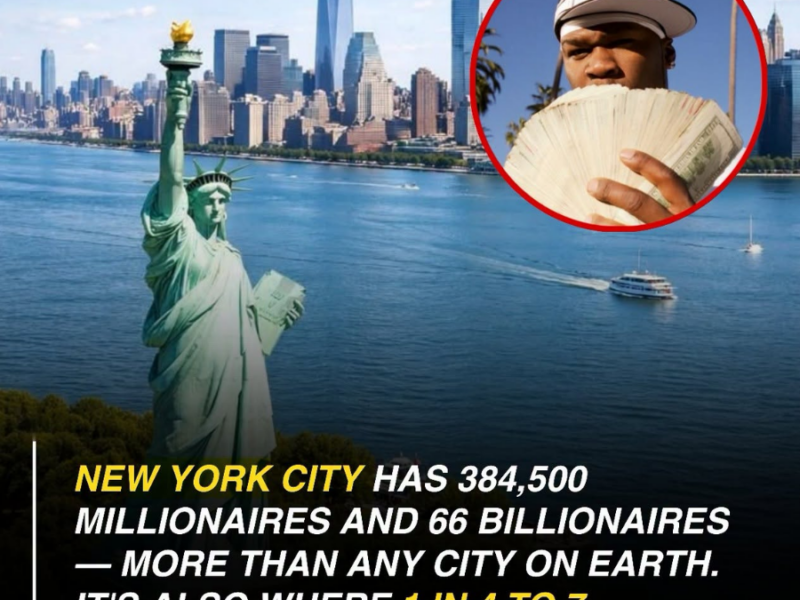
New York City: The world’s wealthiest city—but why is it becoming increasingly difficult for ordinary people to live there?
New York City has retained the title of the world’s wealthiest city for the fourth consecutive year.
Behind the skyscrapers, Wall Street, multi-million-dollar penthouses, and one of the planet’s largest financial markets lies a staggering figure:
384,500 millionaires.
Furthermore, New York is home to approximately 818 individuals with assets of $100 million or more and 66 billionaires.
The city’s total private wealth is estimated at around $3 trillion.
To put it in perspective, roughly one in every 22 New York residents is a millionaire.
New York ranks ahead of other renowned wealth hubs such as the San Francisco Bay Area, Tokyo, Singapore, and London.
Even more notably, the city’s millionaire population has surged by about 45% in just a decade.
By these metrics, New York appears to be enjoying a golden age.
Yet, a very different question arises:
If New York is so wealthy, why do so many ordinary people here find it increasingly difficult to make a living?
This is the city’s most thought-provoking paradox.
New York – a massive concentration of wealth
New York has long been more than just an American city.
It stands as one of the world’s most vital centers of economic power.
Wall Street is a global symbol of finance.
Manhattan is a hub for investment banks, hedge funds, asset management firms, multinational corporations, and countless high-end service businesses.
However, New York’s economic might extends beyond finance.
The city is also a center for media, advertising, fashion, art, entertainment, technology, real estate, law, consulting, and education. Money flows into New York from all corners of the globe.
The wealthy come here to invest.
Companies come here to recruit talent.
Entrepreneurs come here to seek capital.
Investors come here to find opportunities.
And it is this massive influx of capital that has transformed New York into one of the planet’s greatest concentrations of wealth.
384,500 millionaires—a staggering figure.
Just imagine a city with around 384,500 millionaires.
This isn’t merely a small group of celebrities you might occasionally see in the press.
It is a massive community.
An individual with a net worth exceeding $1 million could be a business owner, an investor, an executive, or someone working in finance or technology—or simply someone who has owned real estate and accumulated wealth over many years.
And when these individuals number in the hundreds of thousands, they begin to create their own economic ecosystem.
They buy homes.
They invest.
They hire services.
They frequent high-end restaurants.
They purchase luxury goods.
They invest in startups.
They launch businesses.
They also drive demand for premium, high-cost services.
This is one of the reasons New York is able to sustain a massive market for luxury real estate and high-end services.
818 centi-millionaires and 66 billionaires.
If the figure of 384,500 millionaires is already astounding, the tiers above them are even more remarkable.
New York is home to approximately 818 centi-millionaires—individuals with assets of $100 million or more.
And there are around 66 billionaires.
These individuals possess far more than just cash in the bank. Their wealth is often held in corporate shares, real estate, investment funds, private companies, intellectual property, and various other investments.
As the value of companies and assets rises, so does the value of their wealth.
That is why a city can see a rapid surge in private wealth even when the standard of living for some residents does not improve correspondingly.
$3 trillion in private wealth
This is perhaps the most staggering figure.

Approximately $3 trillion in private wealth is concentrated in New York.
$3 trillion represents a massive amount of wealth.
But there is a crucial point to consider:
$3 trillion does not mean that every New York resident is wealthy.
The city’s total wealth is generated by a large number of asset holders, but ownership is unevenly distributed.
A person with $10 million and someone with almost no savings are both counted as part of the same city’s population.
Therefore, if we look only at total wealth, we might easily overlook another part of the story.
That is inequality.
A wealthy city is not necessarily a livable city.
This is an aspect that many wealth rankings fail to fully capture.
A city can be economically wealthy yet extremely expensive for its residents.
New York is a prime example.
The wealthy may view the city as a place full of opportunity.
But for an average-income family, New York can sometimes feel like an endless race.
Rent.
Electricity bills.
Food costs.
Transportation costs.
Insurance.
Childcare.
Medical expenses.
Taxes.
Monthly payments. All of this adds up to a massive burden.
$5,000 in monthly rent.
One of New York’s biggest challenges is housing.
Recent statistics place the median rent at around $5,000 per month, depending on the area and the measurement method.
For a high-income earner, $5,000 might be an acceptable expense.
But for a working-class family, it could consume the majority of their monthly income.
And the issue goes beyond just the rent price.
It also raises the question:
Where can you actually find a suitable home at that price point?
New York faces immense housing demand.
Millions of people want to live close to their jobs, schools, public transportation, and economic hubs.
Yet, the supply of affordable housing isn’t growing fast enough to meet that demand.
When demand is high and supply is limited, both housing prices and rents face upward pressure.
“The wealthy can buy New York, but ordinary people have to rent it.”
While this statement may be somewhat hyperbolic, it reflects a crucial reality.
For the wealthy, New York real estate can serve as an investment asset.
An apartment worth several million dollars might be viewed as just one component of an investment portfolio.
For the average worker, however, that same apartment represents a monthly expense.
Two people looking at the same property might see two completely different things.
The wealthy see:
“An asset with the potential for appreciation.”
Renters see:
“A sum of money I have to pay every month just to have a place to live.”
That is the gap between asset ownership and the cost of living.
And that gap is widening.
Over the past decade, the number of millionaires in New York has risen by approximately 45%.
This signals that the city continues to attract capital and the wealthy. But it also raises a difficult question:
If the number of wealthy people rises so rapidly, where do average-income earners stand?
If real estate prices rise, existing homeowners may grow wealthier.
But those who do not yet own a home face higher purchase prices.
If rents go up, property owners may benefit.
But tenants have to pay more.
If neighborhoods become more desirable, property values may rise.
But that very trend can price lower-income residents out of the areas where they once lived.
This is a common cycle in wealthy cities.
Poverty can exist right alongside billions of dollars.
This is the most thought-provoking image of New York.
You can stand in the middle of Manhattan and see buildings worth billions of dollars.
You can walk past luxury fashion boutiques.
You can see high-end cars.
You can step into restaurants where a single dinner might cost hundreds or thousands of dollars.
Yet, just a short distance away, there are people who must carefully calculate every expense.
There are families working full-time who still struggle to pay the rent.
There are people living in multi-generational households within tiny apartments.
There are people who commute for hours every day to find housing they can afford.
And there are people constantly at risk of financial crisis due to a single unexpected expense.
That is why calling New York the “richest city in the world” doesn’t tell the whole story.
New York can create billionaires, but it cannot build housing fast enough.
This is one of the greatest paradoxes of the modern economy.
A city that can spawn companies worth tens of billions of dollars.
That can produce hundreds of new millionaires. It can attract thousands of investors.
It can manage vast amounts of capital.
Yet, constructing a new apartment building requires significant time, land, capital, and administrative procedures.
Consequently, capital moves faster than housing can be built.
International capital flows can reach New York in mere seconds.
But a new housing project may take years to complete.
When capital and demand outpace housing supply, residents feel the impact through rising rents and home prices.
The problem isn’t that New York is too wealthy.
In reality, the issue isn’t New York’s wealth itself.
Wealth creates jobs.
It fosters businesses.
It generates tax revenue.
It drives investment.
It sparks innovation.
A wealthy city is, fundamentally, a good thing.
The real question is:
Does that wealth translate into a better life for the majority of residents?
If the economy grows but rents rise faster than incomes, residents feel the pressure.
If asset values climb without a corresponding rise in wages, the wealth gap can widen.
If a city attracts more and more wealthy people without building enough housing, it becomes increasingly difficult for ordinary workers to access the city.
This is not a problem unique to New York.
It is a challenge facing many major cities around the world.
San Francisco, London, Singapore, and Tokyo are grappling with similar issues.
New York is not the only city where wealth and affordability clash.
San Francisco is home to Silicon Valley and massive tech corporations.
London is one of the world’s most important financial centers.
Singapore is an international hub for finance, trade, and logistics.
Tokyo is one of the planet’s largest metropolises.
They all share one thing in common:
Immense economic opportunities—but the cost of accessing them is equally high.
That is why the story of New York is worth noting.
Because it is not just about a single city.
It is about the future of global metropolises.
So, is New York truly the wealthiest city in the world?
Based on private wealth, the number of millionaires, and the concentration of the ultra-wealthy, the answer is yes—according to the rankings in question.
But if you ask:
“Is New York the easiest place for an ordinary person to live?”
The answer is entirely different.
And that is the point worth pondering.
A city can rank first in wealth but not in affordability.
A city can be home to hundreds of thousands of millionaires while others struggle to pay the rent.
A city can possess $3 trillion in private wealth while some families lack enough savings to cover even a few months of expenses.
This is not a statistical contradiction.
It is the result of unequal wealth distribution.
Two New Yorks coexist.
There is the New York of the wealthy.
That is the New York of:
Wall Street.
Manhattan.
Penthouses.
Investment funds.
Billionaires.
Billion-dollar deals.
Apartments worth tens of millions of dollars.
But there is also another New York.
That is the New York of:
Rent.
Subways.
Monthly bills.
Double shifts.
Childcare.
Cramped apartments. And the worry about whether there will be enough money next month.
These two New Yorks are not in different places.
They coexist within the same city.
Sometimes, they are separated by just a few blocks.
And that is perhaps the greatest lesson New York teaches us.
When looking at a city, we tend to focus on big numbers.
GDP.
The number of billionaires.
Stock market value.
Real estate prices.
The number of major corporations.
Total wealth.
But those figures tell only half the story.
The other half is:
How are ordinary people living?
Can they afford to buy a home?
Can they afford the rent?
Are they able to save money?
Can they afford to raise children?
Can they live near their workplace?
Can they take a few months off work if a crisis strikes?
And most importantly:
Do they feel they are moving forward, or just struggling not to fall behind?
These are the questions that truly define a city’s quality of life.
New York is a dream—but that dream comes at a steep price.
New York remains one of the most compelling cities in the world.
It continues to attract talent.
Capital.
Businesses.
Investors.
Immigrants.
Those looking for a fresh start.
Those striving for success.
And those seeking to touch the “American Dream.”
But the cost of living that dream keeps rising.
A city may grow wealthier year by year.
Yet, if housing becomes increasingly out of reach, the cost of living climbs, and the wealth gap widens, that prosperity raises a difficult question:
For whom is this city becoming wealthier?
That is the question New York will have to face in the years ahead. After all, a city is not defined solely by the billionaires living in its tallest towers.
It is also shaped by taxi drivers.
Restaurant servers.
Teachers.
Nurses.
Office workers.
Delivery workers.
Laborers.
Salespeople.
Families raising children.
And millions of other ordinary people who keep the city running every day.
New York may well be the wealthiest city in the world.
But a truly successful city is not measured merely by the number of millionaires it houses.
It is also measured by whether an ordinary person can live, work, rent or buy a home, and build a future there.
And it is here that New York presents a thought-provoking paradox to the world:
The wealthiest city on earth is not necessarily the most livable one.
New York may be wealthier than ever before.
Yet for so many ordinary people, the daily question remains far simpler:
“Do I have enough money to pay the rent this month?”