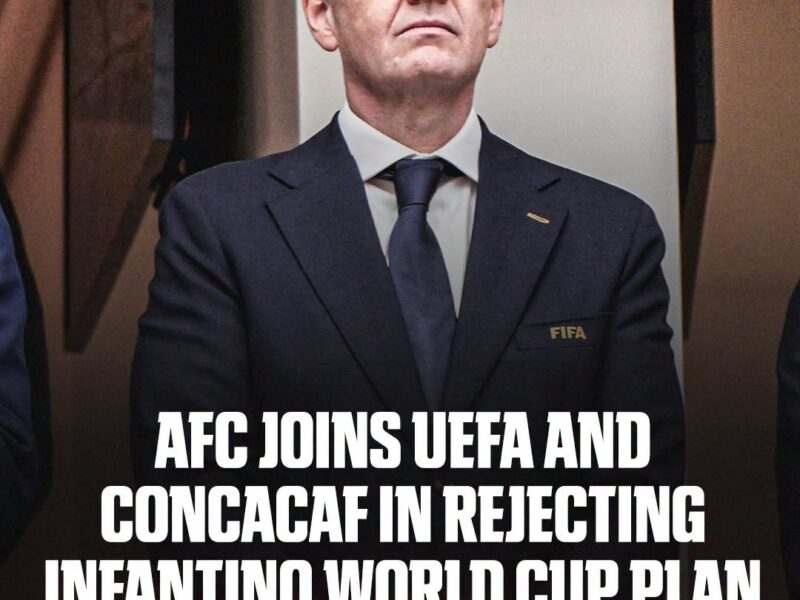
FIFA suffers another blow in the ‘World Cup selling’ scandal.
FIFA’s plan to “sell the World Cup” is facing increasing obstacles, as in addition to UEFA, the Asian Football Confederation (AFC) has now voiced strong opposition.
The plan to take over the commercial operations of the World Cup from a privately held company – essentially “selling the World Cup” – continues to face significant obstacles. The Asian Football Confederation (AFC) recently officially protested FIFA’s approach to the project.
In a letter sent to 47 member federations on July 30, AFC President Sheikh Salman bin Ebrahim Al Khalifa (from Bahrain) stated that the Asian football governing body was “extremely concerned and disappointed” that it was not consulted by FIFA before the plan to “sell the World Cup” – more accurately called FIFA Forward Enterprise (FFE) – was announced.
The AFC has also not yet received a full analysis of the legal, financial, governance, and long-term consequences of the proposal.
Salman called FIFA’s unilateral action “completely unacceptable,” warning that it could undermine the foundations of unity, cooperation, and transparency among football governing bodies.
The AFC president has asked Asian members not to make a decision until the AFC has completed consultations with FIFA and assessed the relevant terms.
The AFC’s reaction is seen as a painful blow to FIFA President Gianni Infantino. Asia has long been one of Infantino’s strongest supporters.

Salman himself has shown close ties with FIFA leaders, while many Asian federations have pledged their support for Infantino in the next election.
According to a proposal announced by FIFA on July 28, the FFE would focus on commercial activities and event organization, including television rights, sponsorships, ticket sales, brand licensing, and the operation of the men’s World Cup, women’s World Cup, and other tournaments.
FIFA plans to sell up to 20% of FFE shares to outside investors, raising up to $4.2 billion against a valuation of around $20 billion.
FIFA affirms that it retains full control of the new company and maintains exclusive rights to the schedule, format, rules, and technical decisions. The funds raised will help increase the total global football development budget to over $10 billion. Each member federation can receive a special grant of up to $20 million, in addition to the proposed increase in the FIFA Forward budget for the 2027-2030 period from $8 million to $20 million.
However, linking large sums of money to a registration deadline of September 19th has led many organizations to believe that FIFA is pressuring its 211 member federations to quickly approve the proposal. FIFA rejects this accusation, emphasizing that participation is entirely voluntary and the plan will only be implemented if it receives sufficient support.
Before the AFC, UEFA strongly objected, arguing that “the soul and governance of football are not assets to be traded.”
The European football governing body convened an emergency meeting with 55 members, during which the possibility of boycotting some FIFA tournaments was discussed, but no official decision was made.
CONCACAF (the North and Central American Football Confederation) was also upset because they only learned about the project through the media and were not involved in the development process.
The World Professional Footballers’ Association FIFPRO, the Australian Players’ Union, and the European Club Representatives’ Organization have also questioned transparency, as well as the exclusion of players, clubs, and fans from the decision-making process.
While CONMEBOL (South America) has not publicly stated its position, CAF (Africa) and OFC (Oceania) are still considering the proposal.
With UEFA, AFC, and CONCACAF all speaking out, FIFA is facing opposition from the three federations representing a total of 143 members.
This development makes the likelihood of the FFE plan being passed unpredictable, and also plunges Infantino into one of the biggest political confrontations since he took over FIFA.